
NthDimension is a high-performance real-time engine for building computational worlds at any scale — combining large-world precision, GPU-driven visibility, physically based rendering, B-Rep modeling, advanced rigging and animation, procedural generation, simulation, telemetry, and governed operational workflows.
What NthDimension Is
NthDimension is a unified computational-world engine for real-time 3D applications, simulation, digital twins and interactive systems. It is designed so rendering, simulation, telemetry, persistence and authoring operate on coherent entities instead of creating disconnected versions of the same world.
- Meaning before geometry: Entities carry identity, state, relationships and behavior; geometry is one runtime projection.
- Scale without precision debt: Hierarchical reference frames and floating-origin policy support environments from local scenes to astronomical envelopes.
- Integrated authoring: Modeling, scripting, rigging, animation, terrain, procedural systems and diagnostics live in one editor/runtime architecture.
- Operational connectivity: Native OPC UA and Modbus integration connect real-world telemetry and control data to the 3D environment.
Interactive worlds
Real-time rendering, simulation, editing, animation, procedural generation, terrain, weather and audio.
Operational worlds
Telemetry, asset identity, persistence, semantic relationships, evidence, diagnostics and regulated workflows.
Architecture
NthDimension combines a real-time engine, editor, asset system and semantic runtime into one architecture. The same entity can be rendered, simulated, animated, connected to telemetry, persisted and inspected without each subsystem becoming a separate source of truth.
- Unified asset model: Stable identity, revisions, dependencies, lineage and provenance across authoring and runtime.
- Reference-frame world model: Large-scale world coordinates resolve cleanly into local render and simulation spaces.
- GPU-driven visibility: Frustum, instance, temporal Hi-Z and meshlet culling reduce unnecessary rendering work.
- Integrated modeling and rigging: B-Rep modeling, skeleton/pose authoring, skinning and animation tools are built into the workflow.
- Persistent scenes: Scene state, assets and authoring data are serialized with migration-aware persistence.
- Extensible runtime: Procedural systems, telemetry, simulation and domain-specific tooling plug into the same engine architecture.
Engine Specifications
Core capabilities of the current NthDimension engine.
Platform & Runtime
- C# / Roslyn scripting and editor tooling
- Modular plugin host and capability registry
- No unsafe code in the main project
Large Worlds & Coordinates
- Double-precision world/reference-frame coordinates
- Configurable universe envelope up to 1000 Mly (1 billion light-years) radius
- Hierarchical reference-frame system
- Quantized floating-origin shifts with hysteresis
- Camera-relative/local render-space projection
- Persistence of authored world/reference-frame state
GPU Visibility & Geometry
- Frustum culling
- Hierarchical-Z depth pyramid
- Temporal Hi-Z occlusion
- GPU instance culling
- GPU meshlet batching/culling
- Meshlet normal-cone culling
- OpenGL multi-draw-indirect path
- Static instancing
Rendering
- Deferred renderer / G-buffer pipeline
- Cook–Torrance PBR
- GGX NDF + Smith masking + Schlick Fresnel
- Linear HDR lighting workflow
- ACES fitted tone mapping
- Bloom
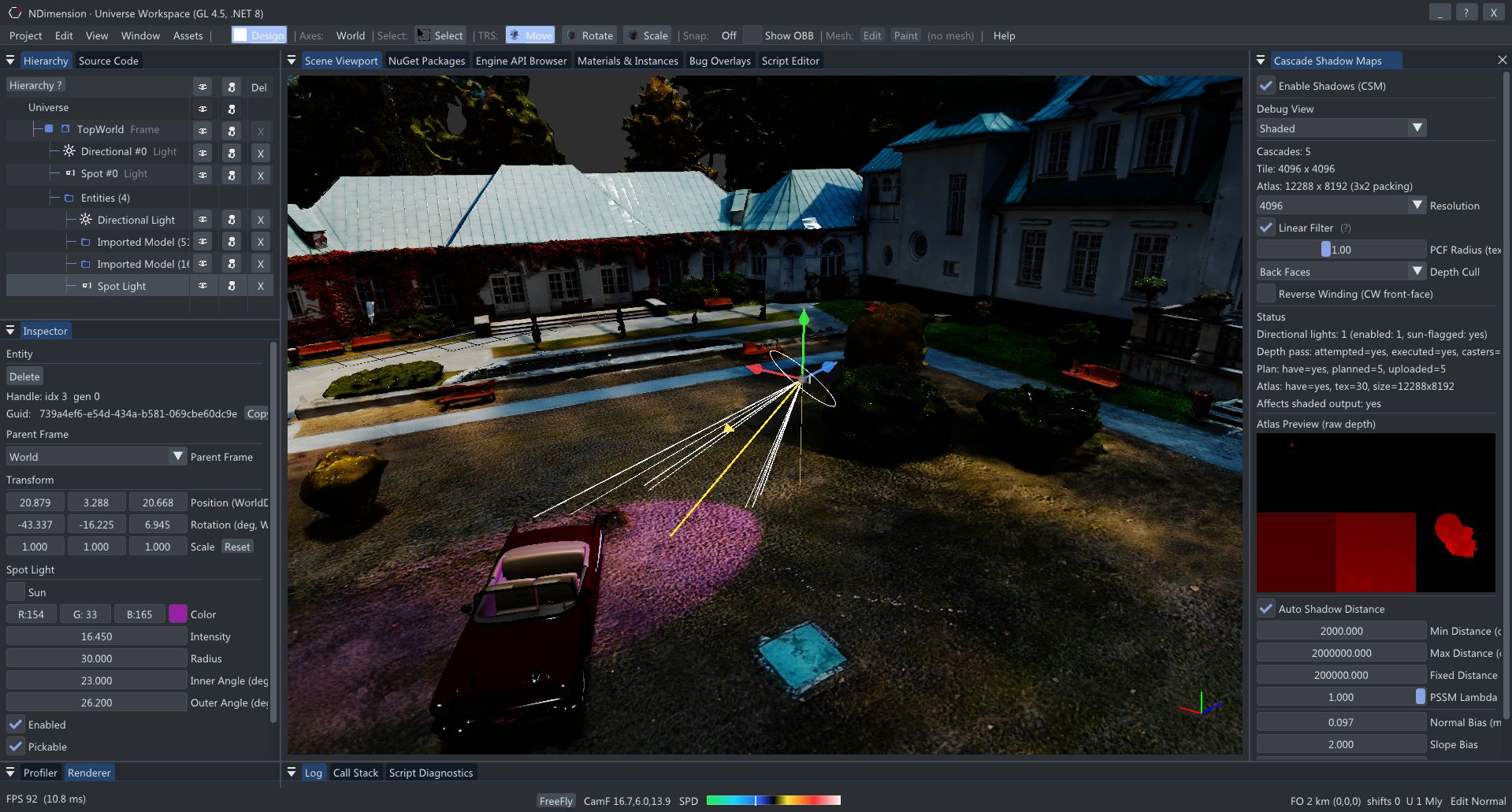
- Cascaded shadow maps
- BRDF integration LUT
- Optional irradiance + prefiltered-specular IBL bindings
- Weighted blended OIT paths
B-Rep Geometry
- Double-precision B-Rep topology
- Vertices, edges, loop uses, face boundaries, faces and shells
- Structural validation and deterministic snapshots
- Euler/topology operations
- Face/edge split and join operations
- Planar-to-B-Rep compatibility
- Architectural realization operations including chamfer/roof/sweep families
Rigging & Animation
- Custom skeleton/rig authoring
- Pose and bone-transform authoring
- Skin-weight authoring
- Up to 8 bone influences per vertex
- glTF JOINTS_0/1 + WEIGHTS_0/1 ingestion
- glTF, Collada DAE and BVH pipelines
- Animation tracks / runtime player
- Retargeting and donor-motion infrastructure
Terrain, World & Procedural
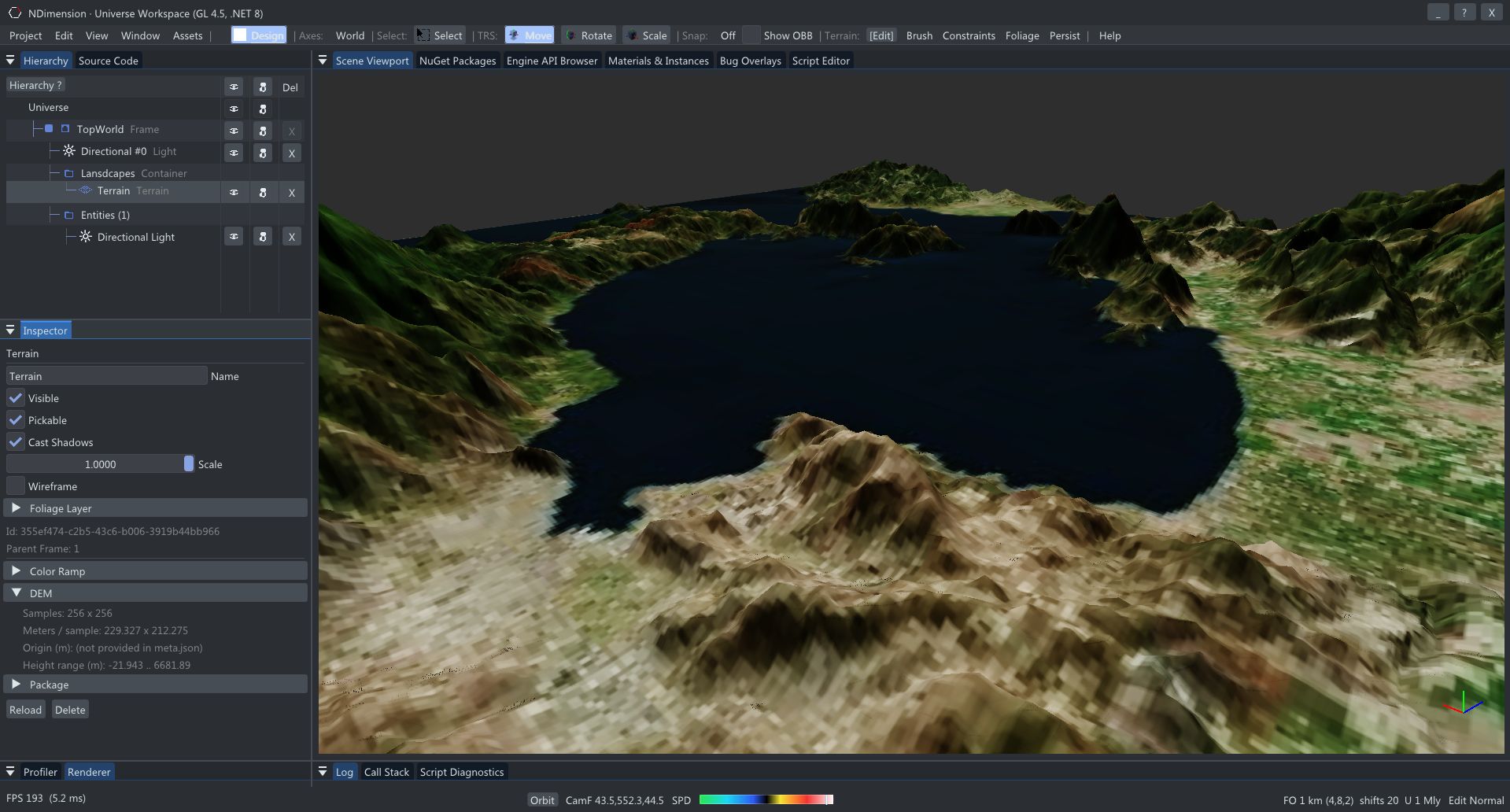
- DEM terrain import/runtime infrastructure
- Tiled terrain world and streaming services
- Terrain LOD transition control
- Procedural terrain height providers
- L-System authoring/generation infrastructure
- Procedural road geometry
- Procedural city and world generation
Weather & Volumetrics
- Atmospheric Mie scattering
- Atmospheric Rayleigh scattering
- Volumetric cloud ray marching/compositing
- Depth-aware reduced-resolution cloud composition
- Rain systems
- 3D lightning/runtime lightning emitters
- Storm-cell state and vector-field infrastructure
- Volumetric VFX ray-march/composite pipeline
- Weather-linked procedural audio
Assets, State & Persistence
- AssetId / revision identity
- Dependency and lineage graphs
- Source provenance and content hashing
- SQLite asset
- Texture, material and static-mesh asset domains
- Runtime representation caches
- Scene persistence with schema migration
- Undo/redo infrastructure
Audio & DSP
- OpenAL transport
- Procedural SFX rendering
- Weather wind/rain/thunder synthesis
- FFT and analysis taps
- LUFS / true-peak analysis
- Tracker/module playback and rendering infrastructure
Industrial & Data Integration
- Native OPC UA integration
- Native Modbus integration
- Telemetry ingestion and data-binding services
- Telemetry-oriented editor/runtime integration points
- Modular industrial connectivity architecture
Authoring & Diagnostics
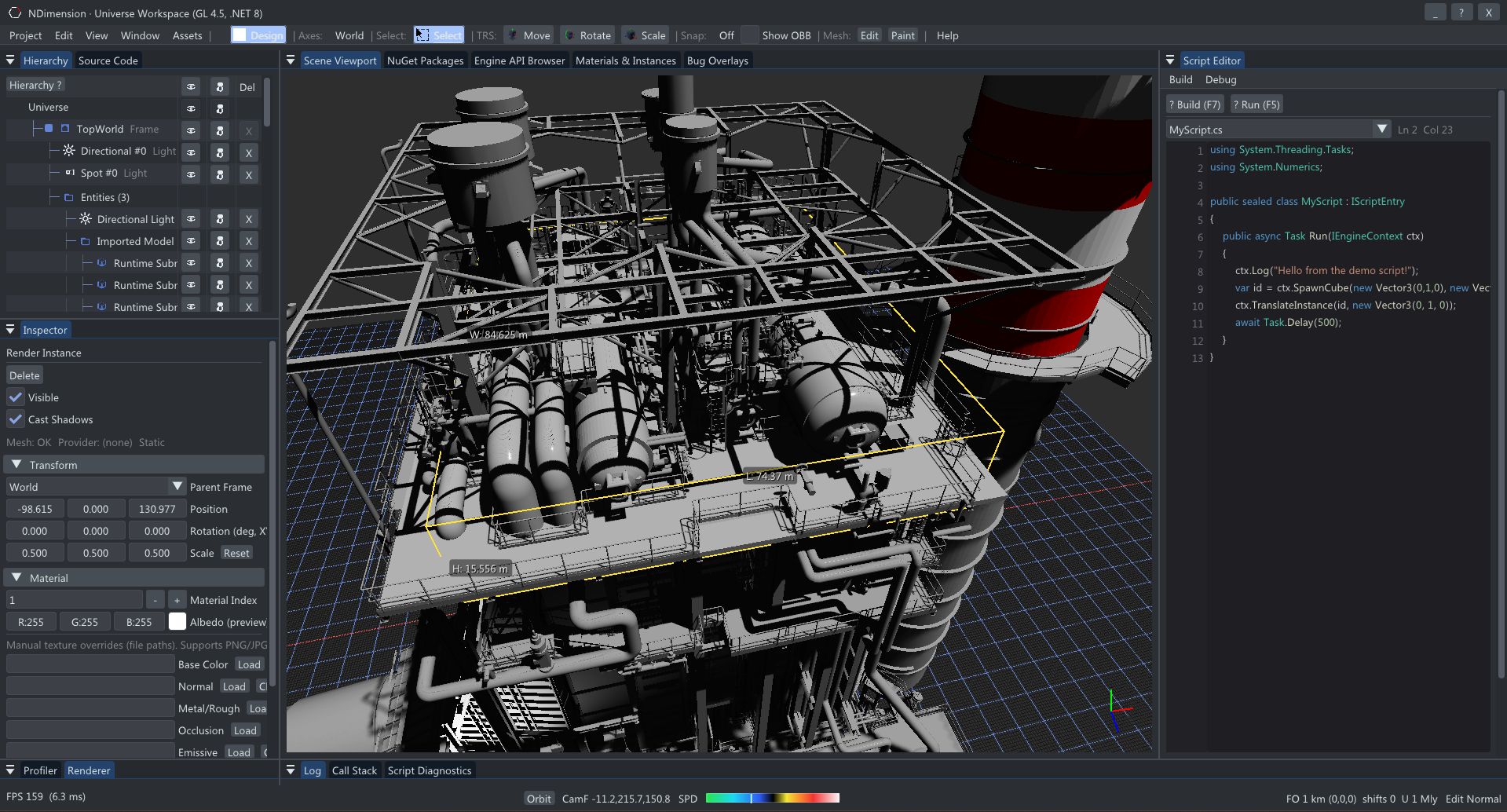
- Integrated real-time editor
- Inspectors and transform gizmos
- Mesh and rigging authoring workflows
- Script IDE / Roslyn language services
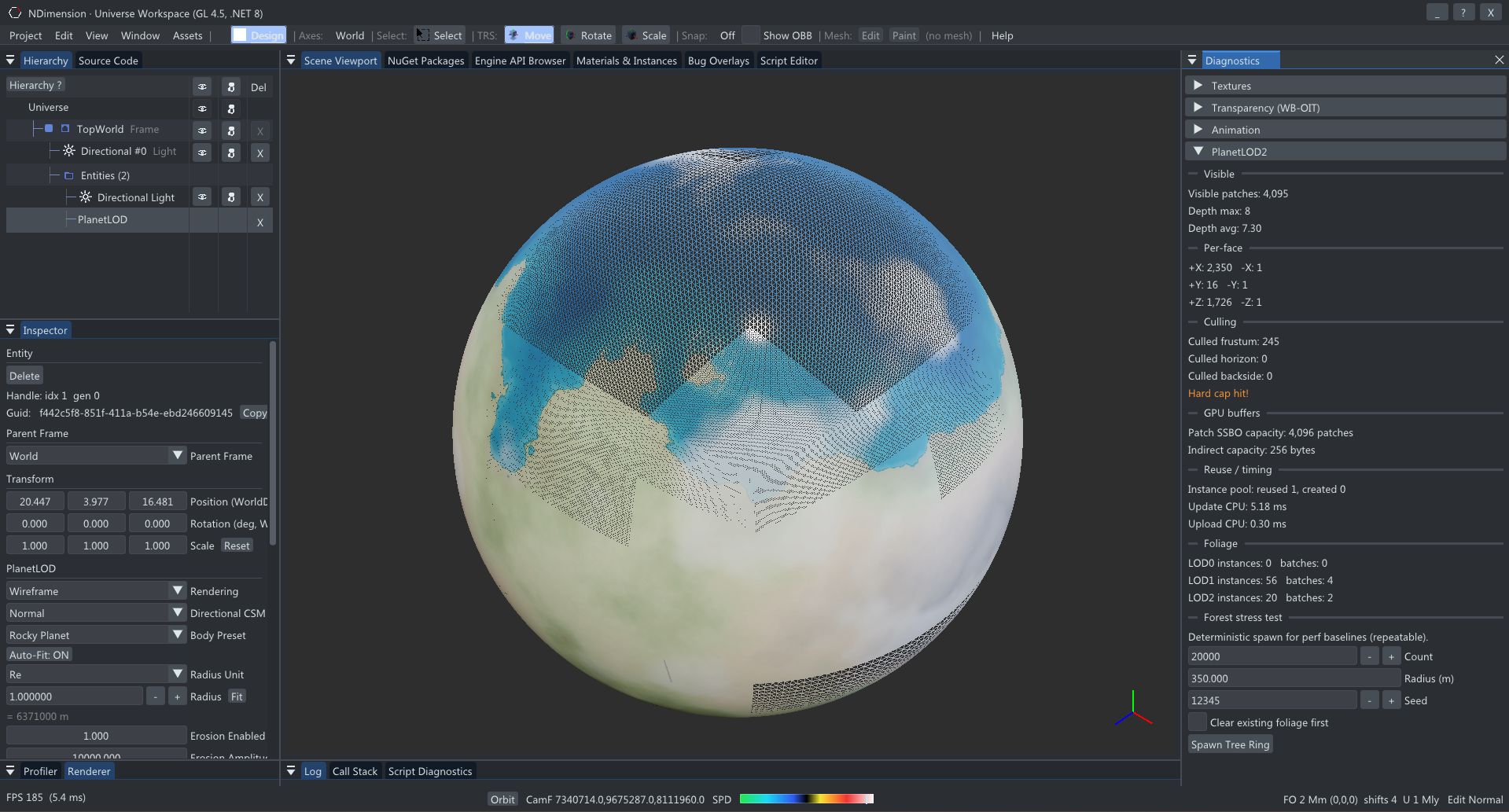
- Profiler and renderer/culling diagnostics
- Startup progress/timing telemetry
- Policy/self-test and nonvisual validation infrastructure
Large-world precision is maintained through hierarchical reference frames and floating-origin/local render-space policy. The configurable universe envelope extends to 1000 Mly (1 billion light-years) radius while preserving high local precision where interaction and rendering occur.
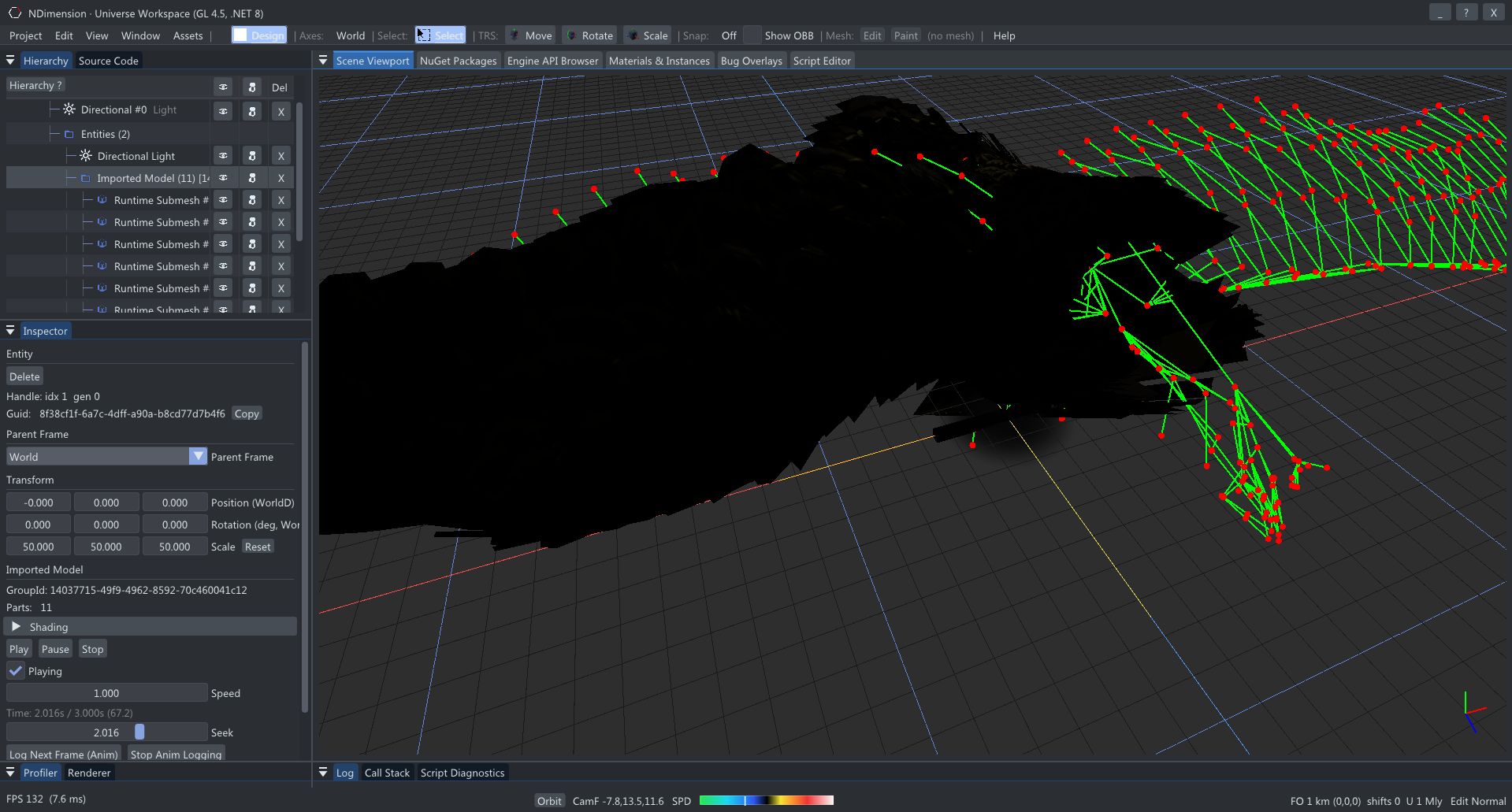
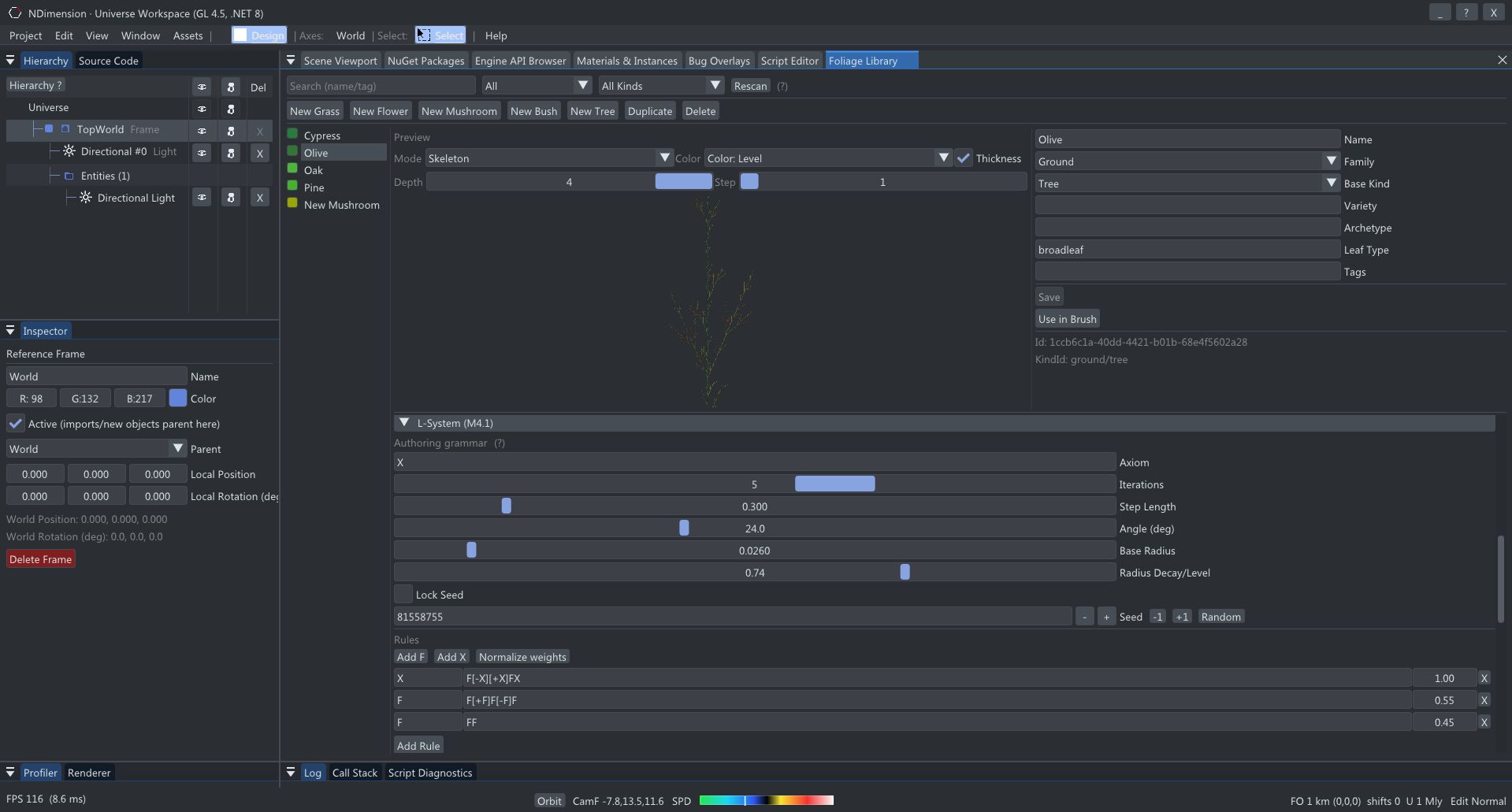
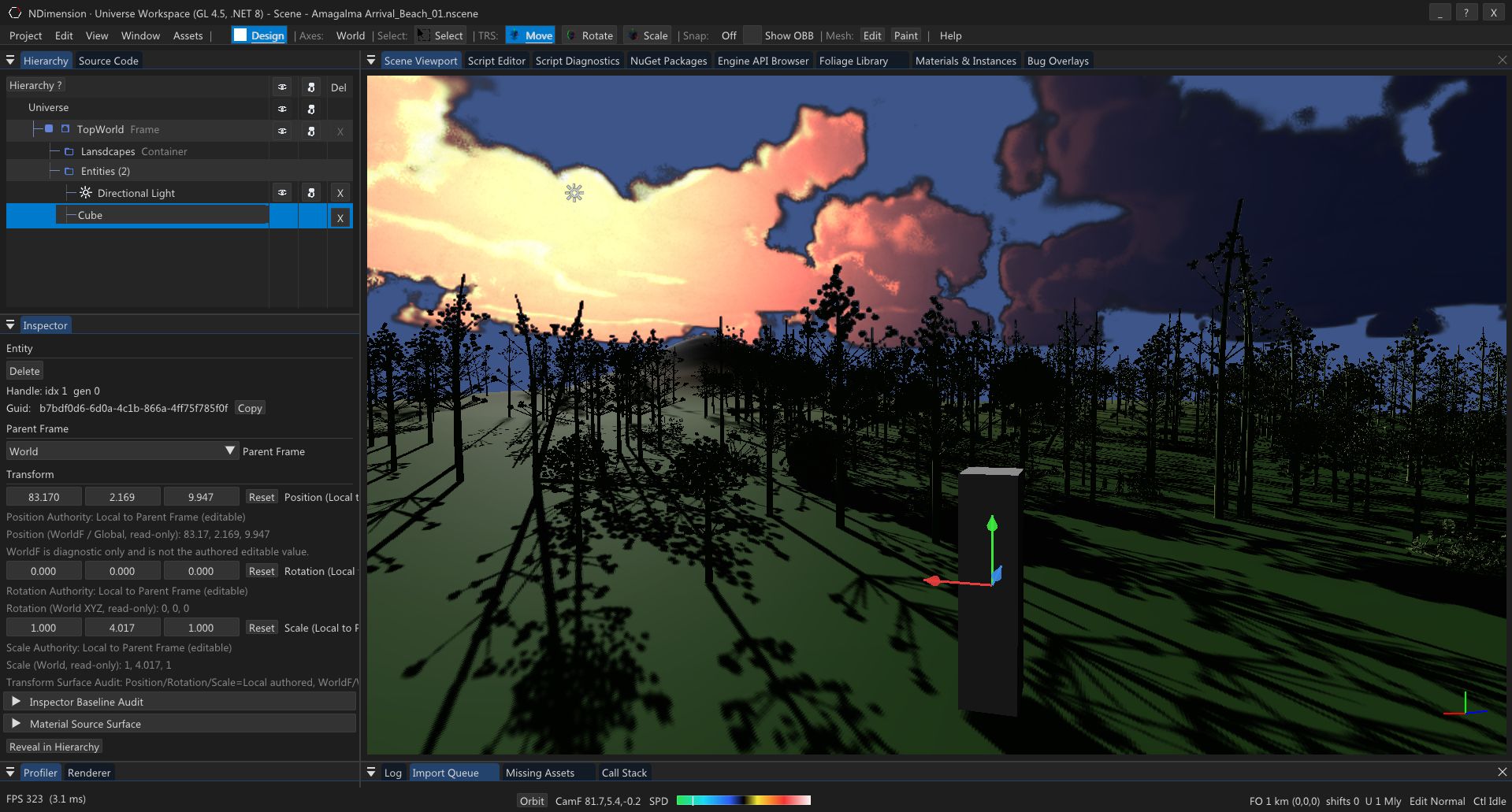
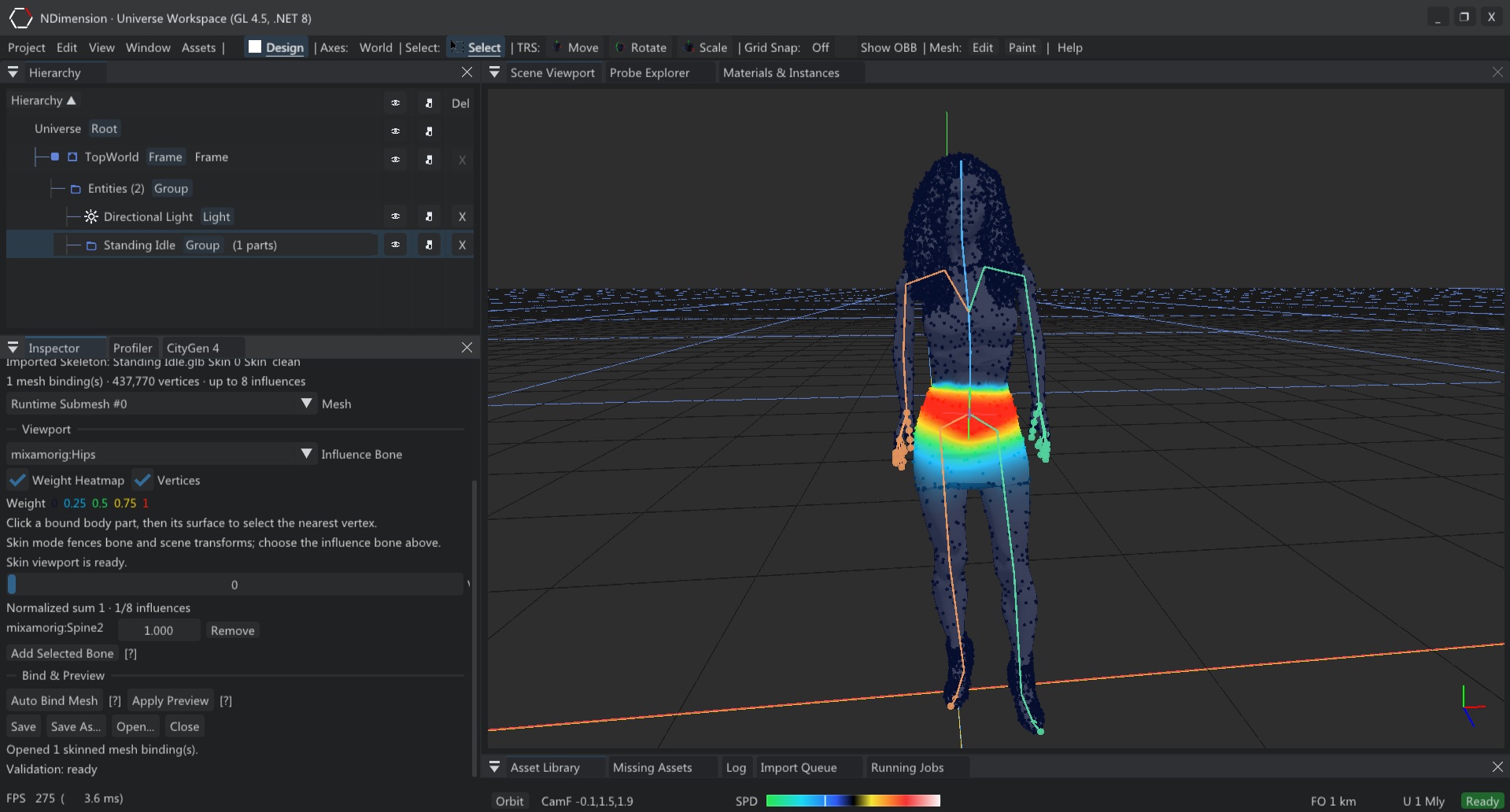
Screenshots
Selected editor and runtime views.
Systems
NthDimension combines its core engine capabilities into higher-level systems for world building, simulation, authoring and operations.
- Asset Library: Versioned assets, dependencies, lineage, provenance, previews, import/admission and runtime representations.
- Terrain & world: DEM and procedural terrain, streaming, LOD transitions and world-query services.
- Procedural environments: L-Systems, roads and active city/world-generation programmes.
- Character systems: Avatar runtime, skeleton/pose authoring, skinning, animation tracks and retargeting infrastructure.
- Weather & volumetrics: Atmospheric Rayleigh/Mie scattering, clouds, rain, storm cells, lightning, volumetric VFX and synchronized procedural weather audio.
- Scripting: Integrated C# Script IDE and Roslyn-backed authoring/runtime scripting infrastructure.
- Semantic infrastructure: Semantic graph, evidence and digital-twin infrastructure for identity, relationships, provenance and operational context.
Engineering
- Diagnostics: Integrated diagnostics expose renderer, culling, startup, terrain and subsystem behavior.
- Reproducibility: Deterministic seeds, content hashes and validation harnesses are used where the domain requires them.
- Failure visibility: Fallback and fail-open paths are explicit and observable.
- Long-horizon maintenance: Policies, migrations, provenance and explicit subsystem boundaries support long-horizon maintainability.
Governance, Integrity & Regulated Workflows
NthDimension includes governance, traceability and evidence capabilities for regulated and audit-sensitive workflows.
- ALCOA+ data integrity: Architecture and workflow design account for attributable, legible, contemporaneous, original and accurate records, together with completeness, consistency, endurance and availability.
- FDA 21 CFR Part 11 readiness: Support is designed around traceability, controlled electronic records, audit trails, identity/authorization boundaries and electronic-signature-ready workflows where the deployed application requires them.
- Provenance & lineage: Asset identity, revisions, dependency graphs, source provenance, content hashes and migration-aware persistence provide evidence about where state came from and how it changed.
- Validation-aware operation: Diagnostics, explicit policies, self-tests and reproducible validation harnesses are used to make important behavior inspectable.
- Shared responsibility: For SaaS or cloud deployments, technical controls are separated from customer procedural, administrative and validation responsibilities.
Compliance is deployment-specific. NthDimension can provide technical controls and evidence mechanisms, but validated procedures, configuration, intended use, organizational controls and operating environment remain part of the compliance boundary.